Insights to Build Your Legacy
News & Insight
Advanced Video Integrity Protection
Advanced Video Integrity Protection
Created: Friday, 15 August 2025 18:34
Advanced Video Integrity Protection Method with Blockchain-Like Hash Linking and Steganographic Watermarking
Introduction: Beyond Conventional Video Security
In the modern information era, video content plays a central role in journalism, entertainment, evidence collection, and corporate communication. Yet, the ease of editing and deepfake creation has made it increasingly difficult to verify authenticity.
We propose an enhanced method of video integrity protection that combines blockchain-style interlinking of video segments with dual-layer watermarking (both visible and steganographic) and an optional online verification service. This approach not only reveals tampering but also makes manipulation significantly harder and more costly, while allowing instant verification.
Core Concept
The idea builds on two main principles:
Blockchain-Like Interlinking of Video Segments From One or More Sources
Each segment (or frame) of a video has its own cryptographic hash. This hash is linked to the hashes of previous segments, forming an internal chain — similar to a blockchain but embedded inside the video itself. (Addition (23.09.2025): as additional protection measure hashes of different sources (cameras, streams) video segments or files can be incorporated in the other video segments, forming united hash or just several hashes on the image. We can call it United Hash Stream or Inter Source Hash Linking. For example we have video 1 and video 2 sources that are recodred to same or different files so file 1 will contain not only hash of its own video (image) but hash of she same time period hash of file 2, and file 2 will contain same additional or mixed hash of file (source, stream) 1. It will additionally improve data integrity protection, especially if 1 and 2 files will be stored separately)Plain explanation: Imagine each frame has a "passport" that lists its ID and the ID of the previous frame. Changing one passport breaks the chain.
Technical detail: The method uses cryptographic hash functions (e.g., SHA-256) to generate segment fingerprints, storing them as encoded data inside subsequent frames.
Dual-Layer Watermarking
Visible layer: A small, non transparent or semi-transparent QR code or visual tag embedded into the frame, containing a segment hash and optional metadata (timestamp, location, color averages (and/or sequence) of selected pixels or blocks).
Steganographic layer: Invisible pixel-level modifications encoding the same or additional hash data, imperceptible to the human eye but detectable by software.
Together, these layers create redundancy: removing visible marks leaves the invisible ones intact, and vice versa.
How It Works
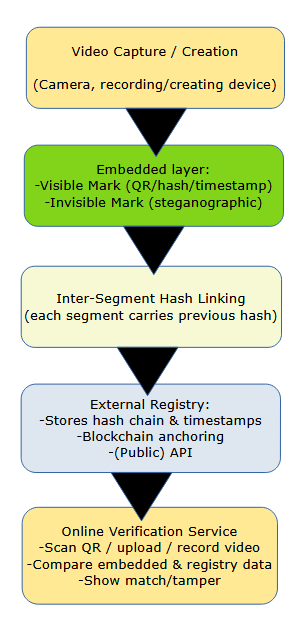
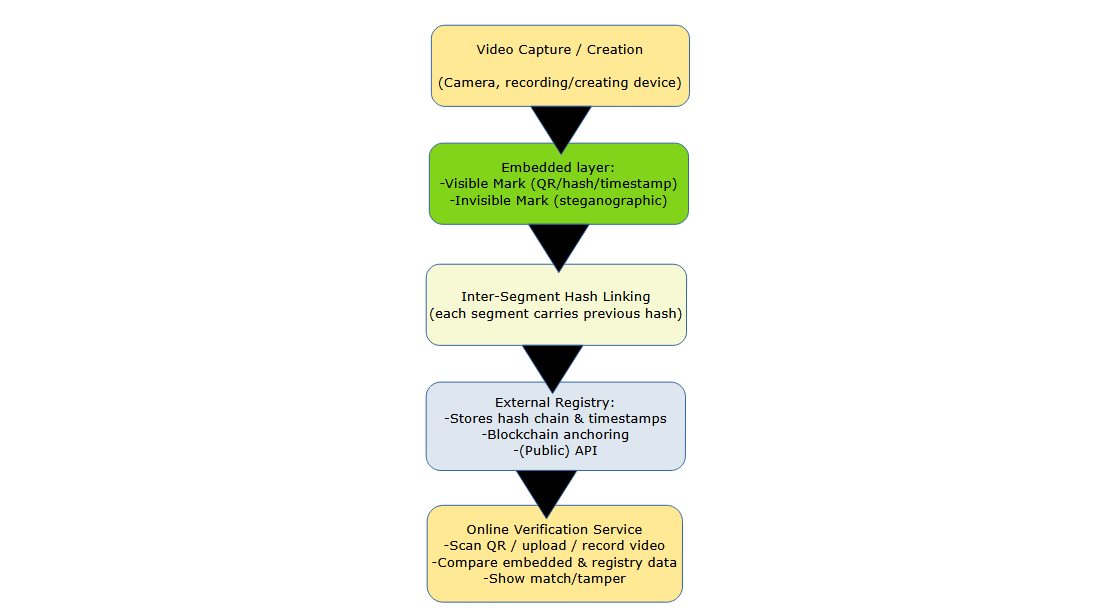
(This diagram illustrates the process from video recording to verification.)
Video Capture
The recording device computes hashes in real time for each frame or segment.
Both visible and invisible codes are embedded into the video stream.
Hash Linking
Each new segment’s hash includes data from previous segments, forming a tamper-evident chain.
Storage & Transmission
Hash sets can be stored locally or uploaded to a secure online service, optionally using a blockchain ledger for redundancy.
Verification
The QR code leads to a verification page showing the expected hash chain.
Any change in the video — even in a single pixel — breaks the chain and is flagged.
The Online Verification Service
We propose an optional free verification platform that could be adopted by platforms like YouTube or independent security providers.
Public API for uploading a video or its hash set for integrity checking.
Automatic screenshots of key frames with embedded codes for manual cross-checking.
Real-time connection mode for devices that upload verification data during recording.
This would allow journalists, law enforcement, and content creators to prove video authenticity instantly.
Unique Elements of the Approach
In-stream hash linking — not only stored externally but also embedded within the video itself.
Combined visible & invisible watermarking — forces an attacker to remove two types of protection.
Multi-layer sync — visible and steganographic codes remain synchronized to make partial edits detectable.
Online integrity registry — optional but adds a trusted external verification layer.
Hybrid hashing frequency — can store per-frame hashes or hashes per time interval for balance between security and efficiency.
Inter-Source Hash Linking — cross-embedding of hashes between synchronized video sources (United Hash Stream) to form a multi-camera integrity mesh.
Patentability and Novelty Potential
While blockchain-based verification and watermarking exist separately, their combined use inside the video stream with cross-layer synchronization and in-frame hash linking is uncommon. The proposed method:
Introduces multi-layer, self-contained integrity verification without requiring constant access to an external ledger.
Applies cross-segment hash chaining inside the video stream, a less explored approach.
Supports real-time external registration during recording — useful for live broadcasting.
As a further enhancement, we introduce Inter-Source Hash Linking (also called United Hash Stream). In this variant, video segments from multiple sources (e.g. two or more cameras or streams) embed each other’s hashes—so file A carries not only its own segment hashes but also hashes of synchronised segments from file B, and vice versa. This creates an interconnected mesh of trust: to tamper with one source undetected, an attacker would need to manipulate all linked sources simultaneously.
In practice, this requires precise temporal alignment and defined segmentation across sources, such that hash embedding remains consistent. The result is a resilient, cross-source integrity network that raises the bar for forgery: any inconsistency between sources triggers detection.
Given these aspects, there is strong potential for patent protection in both method and system categories.
Potential Applications
Media authenticity verification for journalism and social media.
Evidence protection in law enforcement and court proceedings.
Corporate compliance in security-sensitive industries.
Archival integrity for historical records and documentaries.
Related Work & References
Blockchain for Video Authentication
Digital Watermarking in Multimedia Security
Steganography and Hash-Based Verification